Traveling in Iceland
Some useful information - and some just for fun
The Country
Out of a population numbering more than 300.000, half live in the capital Reykjavik and its neighbouring towns in the southwest. Keflavik International Airport is located about 50 km from the capital. The highland interior is uninhabited (and uninhabitable), and most
centers of population are situated on the coast.
Language
Iceland was settled by Nordic people in the 9th century - tradition says that the first permanent settler was Ingolfur Arnarson, a Norwegian Viking who made his home where Reykjavik now stands. The Icelanders still speak the language of the Vikings, although modern Icelandic has undergone changes of pronunciation and, of course, of vocabulary! Iceland is alone in upholding another Norse tradtion, i.e. the custom of using patronymics rather than surnames; and Icelander´s christian name is followed by his or her father´s name and the suffix -son or -dottir, e.g. Gudrun Petursdottir (Gudrun, daughter of Petur). Members of a family can therefore have many different "surnames", which sometimes causes confusion to foreigners!
History
In 930, the Icelandic settlers founded one of the world´s first republican governments; the Old Commonwealth Age, described in the classic Icelandic Sagas, lasted until 1262, when Iceland lost its independence, and in 1944 the present republic was founded. The country is governed by the Althing (parliament), whose 63 members are elected every four years. four-yearly elections are also held for the presidency; President Olafur Ragnar Grimsson was elected in June 1996 to succeed Vigdis Finnbogadottir, and was re-elected in June 2000. The head of state plays no part in day-to-day politics.
Economy
The economy is heavily dependent upon fishing. Despite effort to diversify, particularly into the travel industry, seafood exports continue to account for nearly three-quarters of merchandise exports and approximately half of all foreign exchange earnings. Yet less than 10 per cent of the workforce is involved in fishing and fish processing. The travel industry makes up the second-largest export industry in Iceland. The standard of living is high, with income per capita among the best in the world. The financial sector has been liberalised in recent years. The economy is service-oriented: two-thirds of the working population are employed in the service sector, both public and private. Iceland is a member of the European Fee Trade Association (EFTA) and the European Economic Area (EEC).
Health
Life expectancy, at 81.3 years for women and 76.4 for men, is one of the highest in the world, and a comprehensive state health-care system aims to keep it that way.
Supernatural Iceland - Elves, trolls and ghosts
Surveys show that despite their obsession with modern technology, as many as 80% of Icelanders believe in the existence of elves. Even today, roads have been rerouted and building plans redesigned or abandoned to avoid disturbing rocks where elves are said to live. All around the country, strange lava formations were once explained in folktales as trolls who were turned to stone when caught outdoors in daylight. But only children in Iceland believe in trolls today, and the once widespread belief in ghosts is in decline, some say because electricity has taken the fright out of the long winter nights.
Wildlife - A different kind of fauna
Contrary to what many people think, there are no polar bears in Iceland. Admittedly, every ten years or so a polar bear arrives as an accidental tourist on an ice floe from Greenland, but they aren't invited to stay. The Arctic fox is the only native mammal. Reindeer live in the wild in east Iceland, but were only imported in the 18th century. Mink have also adapted to the wild, the descendants of animals which escaped from fur farms in the 1930s. A number of pedigree animal stocks are found in Iceland which have disappeared elsewhere, descended from domesticated breeds brought over by the Vikings, including the Icelandic horse, cow, sheep and sheepdog. Marine mammals are also found in abundance along the coasts, especially minke whale, humpback whale, fin whale and several species of seals. Some whale watching tour operators claim 98% success rates for sightings.
Vikings in America - Leif the Lucky, discoverer of America
Five hundred years before Columbus, the first European set foot in America: Leif the Lucky, who was born in west Iceland, the son of Erik the Red. According to the Sagas, Leif wintered in a place he named Vinland after grapes he found growing there, around the year 1000. A likely site is Newfoundland, where ruins of a Viking farmstead have been excavated. Leif left the New World but another expedition was led there by Thorfinn Karlsefni and his wife Gudrid Thorbjarnardottir, who explored as far as where New York stands today and spent three or four years trying to establish a settlement before they gave up the idea. While in America they had a son, Snorri Thorfinnsson, the first European born in the New World. Gudrid and Thorfinn left America to live on a farm in north Iceland, Glaumbaer, and when she was widowed she made a pilgrimage on foot to Rome, becoming the first known female transatlantic traveller and undoubtedly the most widely travelled women for at least the next 500 years.
Treeless Iceland - Why aren´t there any trees in Iceland?
Ancient Icelandic writings from the 12th tell how the settlers three centuries earlier found a country that was covered with trees from mountain to shore. The fact that they mention this point suggests that trees were already becoming scarcer then. Over the centuries they were chopped down for timber and firewood, while grazing sheep, harsh winters and ash from volcanic eruptions caused erosion that prevented trees from taking root. Reforestation work began early this century and although there is still only one proper forest in the country (Hallormstadaskogur in the east), Iceland today plants more trees per head of population than any other nation in the world around four million a year, or 16 for every man, woman and child.
Traditional food - Get your teeth into tradition
Most visitors are full of praises for Iceland's ocean-fresh seafood and mouthwatering mountain lamb, but these are only part of the local culinary experience. Traditional food is also served, made using the only preservation methods available when people had to store up for the winter in the days before refrigerators. Some is delicious, some is different, and is very good to boast about to your friends after you've finished it. Meat was commonly smoked, and the delicious hangikjot (smoked lamb) is still popular today. Among dairy products, a big favourite with visitors is skyr (curds), especially served with fresh bilberries in late summer. On the more adventurous side is slatur, which literally means "slaughter" but is like haggis. And for those with nerves of steel and stomachs of iron, the menu for the Thorri midwinter feast (January/February) is a real challenge. Delicacies there include some quite indelicate cuts of meat, including boiled sheep's head (on the bone or pressed), ram's testicles pickled in whey, and loin bags. But what really sorts the men out from the boys is rotten shark, cured by burying, washed down with a well-deserved shot of Black Death schnapps. Hint for beginners: if you manage to get it past your nose, you're half way there.
Ice and fire - Glaciers and volcanoes side by side
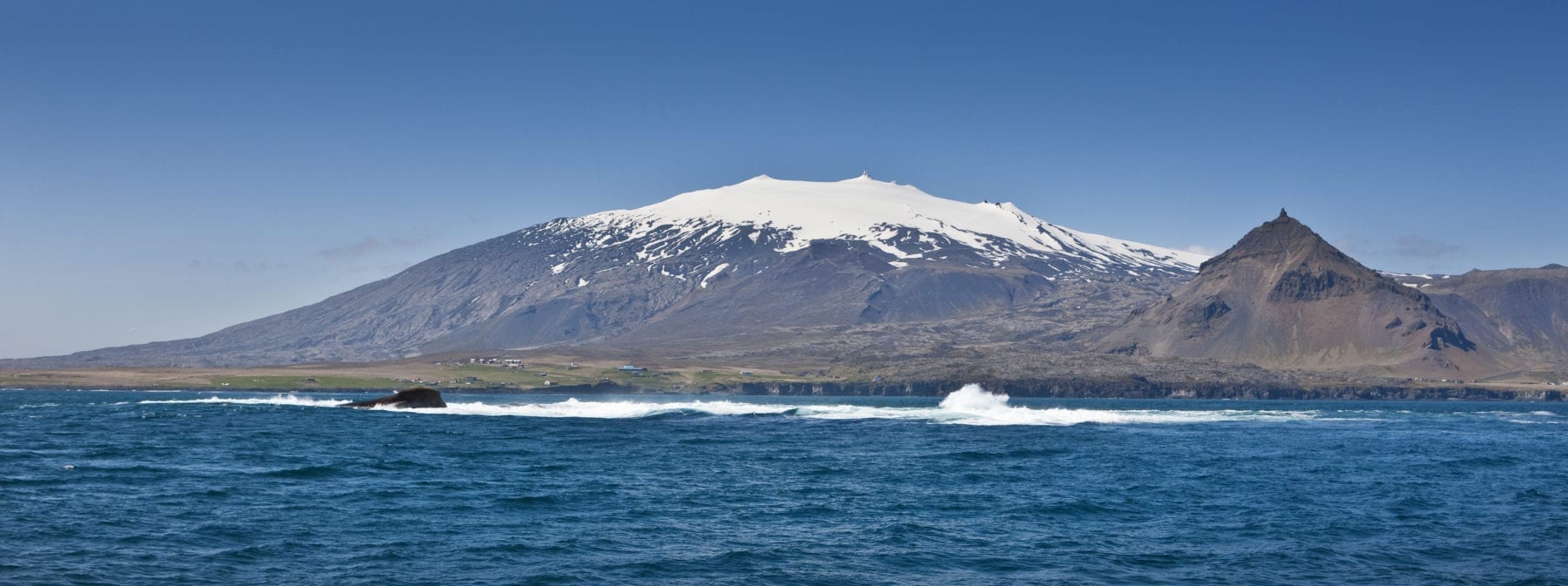
Contrasting forces of ice and fire exist side by side in Iceland. Some 11% of the
country's surface is covered with glaciers and about 30% is lava fields. On average, a volcano erupts every five years, but fortunately only rarely where anyone lives. Vatnajokull glacier, measuring 8,400 km=, is the largest ice cap in Europe in fact it is larger than all the other glaciers in Europe combined. But rather like the character of the Icelanders themselves, there
is fire beneath the icy surface. In 1996 and 1998, volcanoes erupted under the ice of Vatnajokull, pushing up new mountains and causing huge melt water floods along the uninhabited south coast.
Land still taking shape - The youngest country in the world
Geologically speaking, Iceland is hardly out of playschool, since it only began to rise from the North Atlantic seabed about 25 million years ago, the product of volcanic eruptions that are still going on today. Parts of the country are still so rugged that American astronauts chose Iceland as a training ground to prepare them for landing on the moon. And Iceland is still taking shape before peoples eyes: the newest land is Surtsey, an island which rose from the sea during an underwater eruption off the south coast in 1963.
European or American - Is Iceland in Europe or America?
Iceland lies on the Mid-Atlantic Ridge, the mainly underwater border where the tectonic plates of America and Eurasia are slowly spreading apart. A huge rift runs through the country from southwest to northeast, disappearing and surfacing by turns, where the plates are heading in different directions. So although Iceland is geographically and culturally part of Europe, half of it lies on the American plate, and is moving westwards at an estimated 1-2 cm a year. At the ancient parliament site of Thingvellir, which lies on this rift, you can stand on the edge of America (geologically speaking) and see all the way to Europe, 10 km away.
Ancient Viking language - On speaking terms with the Vikings
The Vikings who settled Iceland in the ninth and tenth centuries brought with them their language which has remained basically unchanged ever since. Literacy has been widespread ever since the first sagas were written down in the thirteenth century, and people today can still read them without difficulty. Unlike most western cultures, there are no real dialects and the best language tends to be spoken in the countryside rather than the big city. One strange feature of Icelandic is that it refuses to accept foreign words, but almost always coins new words from ancient Viking roots for even the most complex technological concepts. A classic example is the word for computer: tolva, a hybrid formed from old words for number and prophetess.
Icelandic names - A nation of sons and daughters
Everyone in Iceland is on first name terms, and people are even listed by first names in the telephone directory. Most Icelanders still use the old Viking patronymics instead of family surnames, with different forms for sons and daughters. For example, a man called Haraldur Magnusson and his wife Helga Jonsdottir might have a son called Petur whose final name would then be Haraldsson, and a daughter called Ingibjorg Haraldsdottir. Logical enough, but the naming system sometimes raises eyebrows at passport control and hotel reception desks when Icelanders travel abroad. In the age of
women's lib, increasing numbers of children are being given matronymics, i.e. identified as the son or daughter of their mother rather than their father.
Leisure and sports - Midnight golf and swimming in blizzards
Offbeat sporting attractions have become musts for visitors to Iceland. Top favourite is swimming, courtesy of the geothermal springs which means that people can bathe in warm open-air pools at any time of the year, even during blizzards. A trek on the small but hardy Icelandic horse is another big attraction, the most natural way to travel through nature as it has been for more than a thousand years. Salmon and trout fishing are perennial favourites. On midsummer night, the annual Arctic Open golf tournament in Akureyri, north Iceland, attracts players from around the world in to tee off at midnight in the midnight sun. Action sports are the latest fad, including snowmobiling on glaciers and river rafting on some of the most hair-raising glacial rivers this side of Hollywood.